Antennas & Electromagnetics Group (ANTENNAS)
---------------------------------------------------------------------------------------------------------------------------------------------
** QMUL Honorary Fellow and Antennas Group Visiting Research Associate is the 2009 Nobel Prize in Physics Recipient - Professor Charles Kao**
Part of this year's Nobel Prize in Physics has been awarded to Honorary Fellow Professor Charles Kao for work on fibre optic technology in the 1970s, which he carried out whilst holding the position of Visiting Research Associate at the Antennas Research Group, Queen Mary University of London. Click here for more news on the QMUL website
** For more background information with relation to the Antennas group please click here
---------------------------------------------------------------------------------------------------------------------------------------------
EPSRC PhD Studentship (CASE) on "Transformational Electromagnetics and Metamaterials" is available in the Antennas Group. Informal queries can be made to Prof. Yang Hao.
---------------------------------------------------------------------------------------------------------------------------------------------
**Loughborough Antennas & Propagation Conference (LAPC) 2009**Download Flyer
LAPC 2009 will be held on 16 - 17 November 2009. To maximise the opportunity for productive networking, LAPC organising committee continues the successful format of a series of high-grade invited speaker talks followed by open poster sessions co-located with high quality exhibitors.
---------------------------------------------------------------------------------------------------------------------------------------------

Antenna research at Queen Mary was established in 1968 and since then
has built an international reputation for its research in the areas
of microwave antennas and electromagnetic analysis. The Antenna Measurement
Group's mission statement is "High Quality Research
backed up by High Quality Measurements". Comprehensive
experimental facilities are available at Queen Mary and are housed in
the Antenna Measurement Laboratory.
Research in the Laboratory is directed by Prof.
Clive Parini (FREng) along with 5 full time members of academic staff and
assisted by 4 part-time Research Professors (see People).
Since 2001 the group has:
- Head of Antennas Research Group and Director of Research for the School of Electronic Engineering and Computer Science, Prof. Clive G. Parini, has been elected as a Fellow of the Royal Academy of Engineering, one of the twelve UK academics amongst 45 fellows elected in July 2009.
- been awarded an EPSRC Platform Grant (£1.2m) for work in “ANTENNAS FOR HEALTHCARE AND IMAGING”.
- was awarded a QMUL CIF bid worth £1.338 millions in January 2009 to refurbish the Antennas Measurement Lab buildings and facilities.
- published over 200 journal papers in the highest ranked IET proceedings, IEEE transactions and physics journals.
- published over 480 refereed conference contributions, three books and 16 book chapters.
- secured over £5.6 millions in funding grants from both research councils and other industrial resources (current grant portofolio totals around £3.2 millions).
- graduated one MPhil and 24 PhDs
Research Activities
The Antennas & Electromganteics research group has a strong team
of acadmics and researchers working on various areas realted to antenna
engineering, bio-electromagnetics, novel materials for enhanced performance
and antenna & Em theory and metrology concepts. The group has established
excellent collaborations and links with many academic and industrial
partners working specifically inon antennas and EM problems but also
ranging to problems for wireless communications and medical applications.

Click
on the image above to see an enlarged version of the Antenna Activities
Poster
The research withing the group can be divided into the following themes
(but not limited and often expanded and integrated with other disciplines):
-
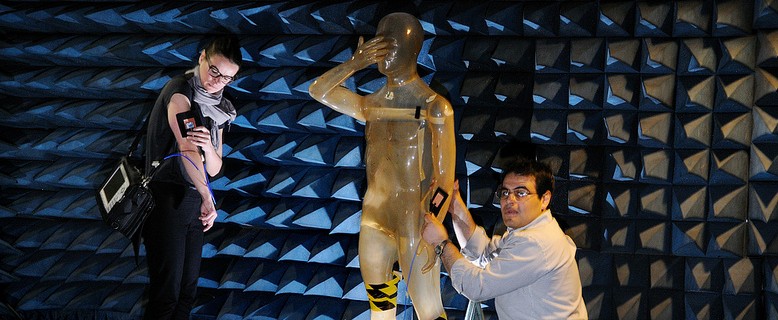
Antennas & Radio Propagation for Body-Centric
Wireless Networks
Work includes but not limited to: Compact, low-cost and efficient
body-worn antenna designs and optimisation, guided-wave solutions
for on-body communications, numerical modelling of wearable antennas
and sensors for healthcare applications, numerical modelling of
radio propagation in complex environments, radio channel characterisation
(statistical and deterministic models), system-level modelling
of potential body-centric communication systems.
For more details: Body-Centric Networks
& Ubiquitous Computing Technology
-
Antennas for Mobile Communications
Work includes but not limited to: multi-band handset antennas;
multiple antennas for Multiple Input Multiple Output (MIMO) applications;
use of Electromagnetic Band Gap (EBG) substrates; semi-smart base
station antennas; antennas and radio propagation for wireless
wearable computers and ubiquitous computing.
-
Theory and Application of Metamaterials
Work
includes but not limited to: dispersive FDTD computational model
for Left-Handed materials; design and applications of EBG structures
and Left-handed materials in microwave engineering.
-
Quasi-optics and Millimetrewave Antennas
Work includes but not limited to: Development of new computational
verification tool based on diffracted Gaussian beams; development
of a tri-reflector Compact Antenna Test Range (CATR); CAD and
experimental verification of a 90GHz integrated active antenna;
active integrated conical horn antennas; theoretical and experimental
characterisation of dichroic plates.
For more details: Millimetrewave
Antenna Research
-
Interaction of Electromagnetic Waves with Biological Tissue
Work
includes but not limited to: Dosimetry and development of full
body SAR model for handset antennas.
-
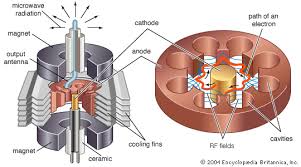
CEM applied to Microwave Electron Tube Devices
Work includes but not limited to: CEM design of magnetrons; low
power phase locking of high power magnetrons (Faraday Partnership).
-
Antenna Theory
Work includes but not limited to: Conformal FDTD; discrete Green's
function FDTD; satellite earth station clutter modelling using
"Power Coupling Theory"; FDTD based antenna array analysis.
For more details: Telecommunications
Research, Finite Difference Time
Domain Research
-
Antenna Metrology
Work
includes but not limited to: Research is focused around the major
antenna measurement facilities of the Antenna
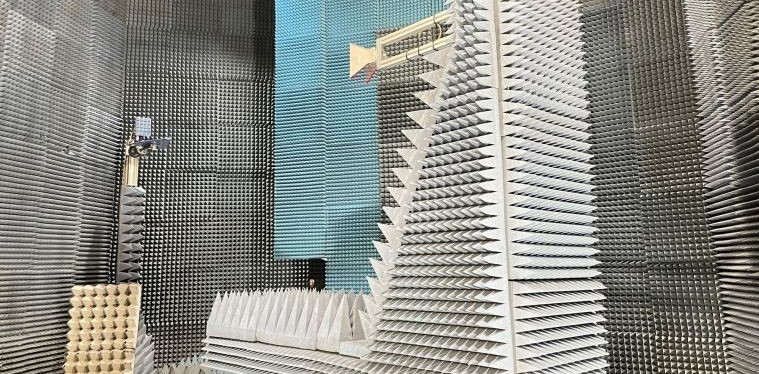
Measurement Laboratory: two compact antenna test range operating
from 5GHz to 300GHz; Fully screened anechoic chamber for mobile
communications antenna applications (750MHz to 5GHz); NSI Planar
near-field range operating to 100GHz; 100GHz quasi-optical test
bench; 9mx3mx3m anechoic chamber for feed measurements and radome
characterisation.
Along with colleagues Stuart Gregson ( Near-field systems Inc)
and John McCormick ( SELEX Sensors and Airborne Systems Ltd) Prof.
Clive Parini has recently published a comprehensive text covering
the theory and practice of planar Nearfield antenna measurement.
|